Showing posts with label cheese. Show all posts

Wednesday, April 22, 2009

Chipotle Cheddar

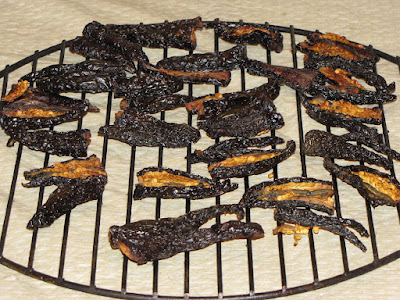
Back in the beginning of March I got the idea to make some chipotle peppers. Chipotles are smoked jalapenos, if I remember correctly they are red jalapenos. Since I was limited to store-bought jalas I had to settle on green ones. I started a low-heat smoke and smoked them for about maybe 8 hours, but I think it was longer. The idea is to smoke them, dry them, but not cook them.


From Cooking, Canning, Gardening


After smoking the peppers I placed them in the oven to dry them completely. I dry herbs and other things in this same manner. Place your oven at the lowest temperature it will go, generally this is 150-170 F, and leave the door of the oven cracked. I sometimes turn the oven off from time to time, just so that it doesn't get too warm. Again, I want to dry them, not cook them.

After they are dried, they can be put into oil, or an adobo sauce, or ground. I ground mine in my coffee grinder. If you do this, be *SURE* to wash out the grinder completely before using it for coffee. Otherwise the resulting coffee will REALLY wake you up.

I wont go into all of the cheese making steps, that will have to come in another post. But what I did was to make a cheese but not age it. It doesn't have some of the flavor that an aged cheese will have, but it is done in 24 hours. I do this occasionally when I need a 'quick fix', and it turns out well.

First I boiled 1.5 TB of the chipotle powder in about 1/4 cup of water for 10 mins. You have to watch this closely so that it doesn't boil dry. Add a bit of hot water if it starts drying too much in the pan.

I used two gallons of milk (store-bought) 1/2 tsp of Calcium Chloride, homemade cheese culture** and 1/2 tsp of rennet to set the curds at 90 degrees. Before adding the rennet to curdle the milk, I stirred in the chipotle powder in water.

After the curds set, the curds were cut into 1/2 inch cubes, then the temp was raised to 100 degrees over about 30 mins. The curds were then poured into a piece of cheesecloth (muslin, not the standard 'cheesecloth' that you see in stores) and drained for over an hour hanging over a bowl.

After draining, the curds are broken up and placed in a bowl and 1 TB of canning salt mixed in thoroughly. Then it was placed into a mold and that placed on my newly-built cheese press.

From Cheese Making


It's a graduated process to press the cheese. First it is pressed at a 10 lbs of pressure for 10 minutes, then the cheese is flipped over in the mold, pressed again for 10 minutes. Then it is flipped again and pressed at 40 lbs of pressure for 12 hours. Since most recipes are written for 4 inch molds, and the homemade molds that I used this time are 8 inches in diameter, I had to double the weight.

Then I let it air-dry for a few hours to get a bit of a rind on it, and I was done. It really has great flavor and a bit of kick to it also.

From Cheese Making


From Cheese Making

** I doubt that the culture was necessary since this is not an aged cheese, I think I did it out of habit more than anything. However, I make my own mesophilic culture and that is very easy. Take a pint of buttermilk and let it sit at room temperature overnight. Pour it into ice cube trays and when it is frozen, break out the cubes and place them in a freezer bags and place in freezer. They will keep for a month this way.
Also, I noticed after posting this that the cheese looks a lot more lumpy/crumbly in the photographs than it really is in real life.

Monday, January 26, 2009

Cheese Fest

It's been a cheese-making festival around here. I've been making a number of cheeses lately, taking my ideas and recipes from Ricki Carroll's "Home Cheese Making" book. Starting out with a simple recipe called Farmhouse Cheddar, I practiced by making about 4-5 one-pound blocks of it. One of them has hot pepper spice added to it, that one should be really good.

It is supposed to age for at least 4 weeks, but my son and I got impatient at the 3-week mark and broke one open. Though you could tell that it was a bit immature, it was starting to develop that slight acidic bite that some cheeses have. It is also a bit flakier/more crumbly than regular cheddar, but was it oh-so-good! My son and I ate a half-pound one evening, and another half-pound a few days later.

After making a number of Farmhouse Cheddar batches, I made several pounds of gouda. There are a couple of differences in making gouda versus cheddar. For one, you 'wash the curds' as it is called. After cutting the curds into about 1/2 inch cubes and heating to about 100 degrees, you replace the whey with warm water. This is done 3 times before the curds are drained and pressed. Also, after the cheese is pressed, it is soaked in a strong brine for anywhere from 3 to 12 hours, depending on the recipe you follow.

I plan on eating at least one of the blocks of gouda after 4 weeks, but also plan on aging one for 6 months. I LOVE aged gouda and now know why it is so stinkin' expensive.

My camera is still broken, sigh... However I have another digicam that is really cheap but will suffice in a pinch, and I was able to get a few pictures of the process.

This is my high-tech cheese press. The molds are PVC pipe, the weights are free-weights, and the pot is a large stock pot that I have.
This is a 1-lb. block of gouda after being removed from the mold, and ready to be soaked in the brine.

This is the gouda while soaking in a strong brine for 12 hours.


Another picture of my high-tech cheese press. Don't knock it, it works great.

Sunday, January 4, 2009

Cheese Head

I got interested in cheese making recently, and of course, had to try it. This looks like this will be fun. I started my first hard cheese Friday night, a Farmhouse Cheddar. My instructor is Ricki Carroll and her book 'Home Cheese Making'. No stinkin' wonder cheese is so expensive; it takes a LOT of milk and forever to let it age. This cheese should age for a minimum of 60 to 90 days, but I know I am going to cheat and at least try it at 30 days.

I started a batch Friday, Saturday and today (in between church services) and they are air drying on my counter for 2-4 days to develop a rind. Then I will be coating them in wax and letting them age. I am thinking that if I start one batch per week that will keep me in cheese heaven. The problem is, it will take me 60-90 days to see if I totally botched them up and destroyed them. Early cheese makers probably went through the same trials.

I wish I could take more photos of the process, because if you know me personally I take pictures of everything. However, after 11,000 pictures my digital camera (Minolta Dimage 5) the shutter button on my camera is stuck, and I'm not sure what I can do about it.

So recently I have cured my own ham from a 3 lb. pork loin and smoked it, started cheese, made some buttermilk, sour cream, butter, made 5 lbs of breakfast sausage, and started 5 liters of red-wine vinegar. Not bad for a wanna-be do-it-yourselfer!

More to come on the upcoming cheese, and hopefully pictures too. Soon to come - homemade bratwurst.

Marty

PS: check out the pictures of Cowgirl's smoked prime rib on her blog (http://cowgirlscountry.blogspot.com/) Oh my goodness gracious, I have to do this now!