Showing posts with label vegetables. Show all posts

Saturday, November 12, 2011

Layered Chicken-Vegetable Soup, Canned

I saw a picture of this online somewhere and I just HAD to make it. Now that I've made it I don't want to open the jars, they are just too pretty!


Here are the ingredients, but there is a lot of room for variations among the vegetables. Amounts are approximate for a one-quart jar:

1 cup cubed potatoes (peeled, raw)
1 cup sliced/cubed carrot
2/3 cup corn
2/3 cup green beans
1/2 cup cooked chicken meat (reserve the broth)
1 Tablespoon (or more if you like) Onion
2 Tablespoons chopped fresh Roma tomatoes
1/2 Chicken bullion Cube

Cook the chicken in seasoned, simmering water for about 20 minutes. Remove bones and excess fat, and cut into chunks.


I used baby carrots which made it easier to chop into a consistent size.


The corn and green beans were frozen. I wouldn't suggest using already-canned green beans or corn because they are going to cook AGAIN for a long time.

The potatoes were cut to about 3/4 inch cubes.


Layer each of these ingredients into a one-quart canning jar. Alternate darker and lighter colors for a good look to your layers. I arranged mine in this order; potato, carrot, green bean, chicken, corn, tomato, onion.


Cover with the broth that you made when you cooked the chicken meat, leaving 1 inch of headspace. PRESSURE CAN at 11 lbs for 90 minutes, allowing for your local elevation.

Something I did was I made extra chicken and broth. I saved the extra chicken for another meal, but then I canned the extra broth. First I allowed it to cool, then skimmed off the fat on top. Then I strained it thru a fine strainer. Muslin might be a good strainer for this, also. For the broth it was also processed for 90 minutes at 11 lbs of pressure. Now I have quart jars of chicken broth all ready for whatever I want to use it in.


Wednesday, March 9, 2011

Leftover Garden Peppers


I should have written about this last summer, but I had stepped away from the blog for a while. Between the wedding/honeymoon, then Sue moving in, this blog just wasn't a very high priority.

I just wanted to tell you a quick hint as to what to do with leftover garden peppers. And this applies to just about any pepper variety that you can grow. Basically I dehydrate them, then grind them into powder for use in many various recipes. I have a dehydrator, but this is NOT necessary since I did this for a long time before I had a dehydrator. You can simply use your kitchen oven.

Keep your peppers sorted by variety through this process. However, I put all mild/sweet peppers like sweet banana, bells, into one pile. I make a sweet-pepper powder out of all of these mixed together.

Cut the peppers into 1 to 2 inch pieces, I don't bother with skinning them first. For oven drying, set your oven to the lowest setting it will go, mine goes down to 170 degrees F. Place the peppers on some type of rack or screen that has holes small enough to keep them from falling through the holes. A screen works better than a cookie sheet because it allows air to circulate over the peppers better. Now place something that won't melt in the door of the oven to keep it cracked about an inch or so.

It will probably take you at least 12 hours for them to dry enough to grind. They need to be completely dry and crisp in order to be ground. Then grind them in a coffee grinder or food processor, even a blender will work. I use my blender because it is glass and the dry, hard pieces of pepper won't mar the glass like they do in my plastic Cuisinart food processor.

It's the same process with the dehydrator, drying them until they are totally dry and crisp.

Since I took the picture above, I have found some good supplies of decorative bottles and jars, and I also make labels on my computer. They look better and make great gifts this way.

I especially like the sweet-pepper powder. It adds a great pepper flavor to dishes but adds no heat.

Saturday, March 5, 2011

Early Vegetable Gardening

I'm in zone 5, bordering on 6 and warm-weather crops like tomatoes and peppers have to wait until May, sometimes LATE May, to be planted. Our late winters are usually very wet also. But don't let this stop you from planting cool-weather crops nice and early. If I had to wait for the garden to warm up and dry out so that I could run the tiller, I would be waiting a long time.

I went out the other day, March 3rd, and planted two types of lettuce, spinach and Sugar Snap peas. If all goes at least halfway decently with the weather, I should be eating salad by the end of April or the firt week of May. Many people wait until they can run their tillers to start planting, but here is what I do.

Take a grass rake and clear the leaves and sticks from an area you want to plant. Then scrape the ground (it was pure wet muck when I did this) with the rake and loosen up the soil. You don't have to go very deep, I probably only loosened to about 1 inch deep, if that. Then scatter your seeds in a wide row, my rows were about 1 foot wide. While holding the rake straight up and down, LIGHTLY tamp down the area with the flat side of the rake.

I didn't have any dry, loose soil to cover it but tamping the seeds down in that rough soil should suffice. Just for a light mulch, I grabbed handfuls of some grass cuttings that were in a pile from the fall, and lightly covered the seeded area to give it a light mulch.

I have been doing this for some years now and it usually works well. I have even had snow on my spinach before, but it didn't harm it. I am a very competitive person and it's always fun to eat a salad from your garden at the beginning of May, but I make sure to tell my gardening friends that I did so! Yes, I like to rub it in. This is about the same time most people are thinking of buying their seeds, but you will be eating from your garden already.

Here is a picture of what the garden looks like right now. Yes, it is trashed and I have my work cut out for me. But I still was able to plant the other day on the back side of the garden where it is cleared somewhat.


This will be a fun picture to look back on later on this year, after I have everything cleared out and the veggies planted.

Friday, May 7, 2010

Spring 2010 Garden Update


As you can see above, I cut my first salad this past Wednesday, May 5th. I use May 1st as a target date; last year it was about April 28th, the year before it was about May 5th. As I have stated before, I like to harvest my first salad at about the same time most people are thinking of breaking ground and buying seed. I'm fairly competitive, even with my gardening. I think they should come out with a full-contact gardening Olympic event.

Here I am cutting my first spinach, lettuce and pulling a green onion for salad


The two rows of green in the pic are two different plantings of spinach. I grew a lot of it and hope to blanch/freeze some of it.

You can't see it in the pic but in the back row is garlic, in between the two green rows are a couple rows of onions. I'm going to plant more onions from sets because I end up eating so many pulled early for green onions for salads.

My taters are popping through the ground too. Yukon Gold was the variety I planted this year. I've had pretty good success with that variety, and can't wait for my first 'new taters.'

Every year I try something new, and this year it is kale and collards. They popped through the surface just in the past couple of days. I just discovered collard greens this year, and really like them. I cook them with a piece of bacon added to the pot, then add vinegar to them when I am ready to eat them. That's how I learned to like spinach when I was a kid, the vinegar really made it good.

I also have Bibb and a Black-Seeded Simpson lettuce that are ready to be cut. You have to plant lettuce and spinach early, they don't do well after things heat up outside. I usually plant these early veggies about mid-March here in central Ohio.

Sugar Snap peas are an edible-pod pea variety and I planted two 10-foot rows of those, each row on other sides of a trellis. I trellis them with a couple of 2x2 posts with wire strung between the posts. What I don't eat fresh I blanch and freeze, then vacuum pack.

I have grown herbs for a number of years now, but increased my planting this year. Usually they are limited to my small herb gardens, but planted a couple of 10 foot rows of basil, and a row each of cilantro and parsley right in my veggie garden. I think I might be able to sell some of them at a local farm market(?) Even if I can't sell them, fresh herbs are a great gift and I will give a lot away to friends and neighbors.

Purple basil is something I discovered last year. It can be used as any other basil, but I infused vinegar with it and it looks beautiful. The vinegar turns a beautiful purple/pinkish color and has the basil taste also. So I am growing it again, but this year I am growing a row that is about 6 feet long.

Most of my perennial herbs are doing well again this year; sage, oregano, lemon thyme and lime thyme, chives (and some garlic chives.) I planted tarragon last year, for making tarragon vinegar, and didn't realize until this spring that it is a perennial also. It came up with a fury and my tarragon plants are already a couple of feet tall!

Tarragon:


I planted a LOT of sweet basil this year. I like to use it fresh in cooking, but a good way to use it is to make pesto. I make large batches of it then put it in ice cube trays and freeze it. Then I put the cubes in freezer bags. I can already taste it spread on a piece of homemade Italian bread, or a dollop of it in a pasta dish.

Here is one of my two little herb gardens as it looked the other day. I will plant a few more things in the spaces that are open. The 2 potted plants are my babies, my bay trees. You can't beat fresh bay leaves for cooking and you won't go back to store-bought, dried out bay leaves once you have tried the fresh ones.


The fall is when you are supposed to plant garlic, and I usually do plant it then. However, it just didn't work out this past fall, and I planted the garlic early this spring. If you plant in spring, the bulbs are much smaller compared to autumn-planted garlic. I had some HUGE garlic bulbs the past couple of years, and I am kicking myself for not planting it last fall. Oh well, there's always next year...

Just for kicks and giggles, I planted a line of Mammoth Sunflowers in the back row of the garden. That should look pretty nice, and they produce quite a few seeds for eating, roasting, etc

The temperature is supposed to go down to an overnight low in the high 30's this weekend, so I am going to wait to plant the maters and peppers. I can, however, plant broccoli and cabbage any time now, they tolerate cool temperatures very well.

My grapes (Concord and Catawba) are growing well too, and showing small flowers/bunches already. I need to spray them with Mancozeb soon, this will help prevent what I think is called black rot. The grapes will form normally, then almost overnight a black spot appears on the end of the grape and the whole grape dies, and dies quickly. One day you notice a spot on the grapes and in a couple of days your grapes are gone. It broke my heart when that happened a couple years in a row until I discovered Mancozeb.

I think I am losing my favorite tree, my sour cherry. Last year the leaves formed then a large number of the leaves just wilted, and I didn't get any cherries from the tree. This year it appears that the same thing is happening. I need to get a picture to the extension office or some other experts for their opinion of what is happening.

So the garden is progressing. I'm eating out of the garden already, but still have things to plant as soon as I can, and when the weather permits. Things are getting pretty exciting for this gardener
!

Sunday, June 28, 2009

Freezing Broccoli

I cut broccoli tonight for the first time this year. It really is growing well this year; one of the heads was at least a foot across!
From More Blog Pics


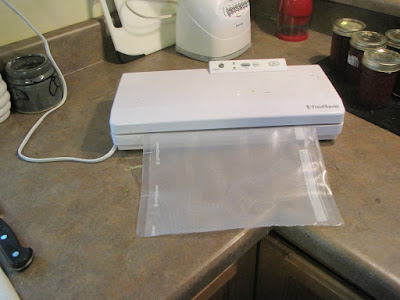
Last fall I bought a FoodSaver vacuum sealer and it is really going to come in handy with freezing vegetables. I have already used it to freeze meats, and did some pea pods with it a couple of weeks ago.
The first thing that you need to do before you freeze broccoli (and many other veggies) is to blanch it. This is simply dipping it into boiling water for 3 minutes, then plunging it into a clean sink full of very cold water. The cold water stops the cooking process immediately. Blanching stops the action of the natural enzymes in the vegetables, enzymes that could cause discoloration, off-flavors and toughening of the vegetables.
The vacuum sealer is fun and easy to use too. The bags come in rolls and you cut off the amount that you need. Then you have to seal one end of it:

From More Blog Pics


Then I place the amount that I will use in one or two meals, any more will probably end up being wasted.

From More Blog Pics


Then the remaining open end of the bag is placed over the sealing strip of the sealing unit.

From More Blog Pics


Then close the lid and turn it on.

From More Blog Pics


In just about 20-30 seconds it sucks all of the air out of the bag and seals the open end with heat.

From More Blog Pics


I always mark the bags before I freeze them with the date and contents.

From More Blog Pics


Without much air in the bag, the contents will last much longer and without much danger of freezer burn.

Sunday, June 7, 2009

Still Planting In The Veggie Garden

I ran out of room in the garden. I think no matter how much room I will ever get, I will fill it up. This is not unlike the fact that as people make more money they will spend more money also. I even have a 'second addition' to the garden that I started last year behind my shed. That is where I grow my melons and such, the things that really spread out and take up room.

I had planted a row of 25 red raspberries on the edge of my property, close to my 2 lines of asparagus. I noticed that the one row of asparagus was way too close to the raspberries and decided to till that line of asparagus in and remove it. That left a wide (5 feet?) area in between the asparagus and raspberries. I was thinking that will be a waste of space, until the raspberries grow up in a year or two, so I decided to use it more effectively.

I made a long narrow hill of dirt about 20 feet long and planted the carrots on the top of the hill. I've done this before and the carrots grow easier in our clay soil this way, in fact they grow GREAT this way for this type of soil. I grow the Danvers Half Long variety which don't grow nearly as deep as other varieties. In the area next to the hill I broadcast the rest of the carrot seed over a wider area. I wanted to experiment and compare growing them in the hill, versus broadcasting them on a flat piece of ground.

That was about half of the open area I decided to use. In the other half, I planted 2 varieties of beets; Cylindra, and Detroit Dark Red. I would have planted all of it as Cylindra but decided to use the seed that I had on-hand. Cylindra makes a wonderful bet that is in more like the shape of a carrot than the typical round beet. This makes for very uniform slices and is nice to use in pickling.

So here it is June 7th and I am still planting away. I will post some recent pics of the garden process very soon.

Thursday, April 23, 2009

Early Garden Progress

We are getting closer to the time when we can plant warm-weather crops here in central Ohio, but we aren't there yet. I was at a local nursery today and wondered how many of the people buying tomato plants were going to be planting them today or very soon. It's always a disaster when they try, more cold is coming sometime between now and the 2nd week of May.

However, I am going to experiment with some early tomatoes, using my Wall-O-Water plastic protectors. I started last year at the beginning of May using them, and they worked great. Now I want to push it up a week and try planting here now during the 4th week of May. I have heard people starting a lot earlier than this using the WOW's but I want to ease my way into it, and experiment with 4 Better Boy plants. I should be planting those tomorrow, and will report on their progress.

As I said in a previous post, I planted some early crops as early as March 10th. I also posted a picture of the spot, though it was bare. So here is the same spot as of yesterday, April 23rd:

From 2009 Garden

Left to right are spinach (Bloomsdale) looseleaf lettuce (Salad Bowl), bibb and romaine lettuce, and radishes. The romaine is from seeds I kept from last year, something I want to do more with other vegetables.


And nearby here are the peas (Sugar Snaps):

From 2009 Garden


So things are growing, thriving so far in the garden. The target date that I set months ago for that first salad is May 1, that might be a bit overambitious. However, the weather forecast shows that it is going to be quite warm between now and then, so we will see.

Friday, March 27, 2009

New Babies

The early crops are already popping up, and they were planted less than 2 weeks ago. I read on the back of the seeds packages and for the early crops it says "Plant in early spring as soon as ground can be worked'. I figure that if I can scratch a line in the muddy and/or frozen ground to place a line of seeds, then that is the ground being worked. And every year I hear at least a few people saying that 'it's too early, you can't grow anything yet'. Those are the people that I like to take a bowl of salad to in the first week of May. That's about the time they are thinking about what seeds they should buy.

On March
14th I planted my first early crops and by March 24th I had 3 types of lettuce, spinach, peas and radishes visibly growing above the ground. Also, I have my rhubarb and the garlic that I planted last fall coming up. If the weather doesn't take a turn for the worse, then I might be eating salad by the end of April, and just might set a personal record for the earliest salad. My personal best so far was last year, I had my first salad on May 5th.


Here's some new-baby pics:

Asparagus
From 2009 Garden


Sugar Snap peas
From 2009 Garden


One of my 3 varieties of lettuce
From 2009 Garden


Spinach (my favorite!)
From 2009 Garden


Rhubarb
From 2009 Garden


Garlic
From 2009 Garden


Yes, it's early, but many veggies THRIVE when it's early and either are stunted or bolt when it gets hot.